How Range is priced
A band on the closing price, backed by a funded reserve.
Range lets you choose a lower and upper price, then call Inside or Outside at the Window's close. It concerns the final closing print. The price can cross either boundary during the Window without deciding the result.
Explore each part and its connections. Expand to use more of your screen.
Follow an arrow to explore a connected part.
Low · high · Inside / Outside
What this part does
The user names a Window, lower and upper price, and whether its closing answer should finish Inside or Outside the band. The chosen maximum payout shapes the quote.
Outgoing connections
- From Choose a bandget quoteAction or record
The user names a Window, lower and upper price, and whether its closing answer should finish Inside or Outside the band. The chosen maximum payout shapes the quote.
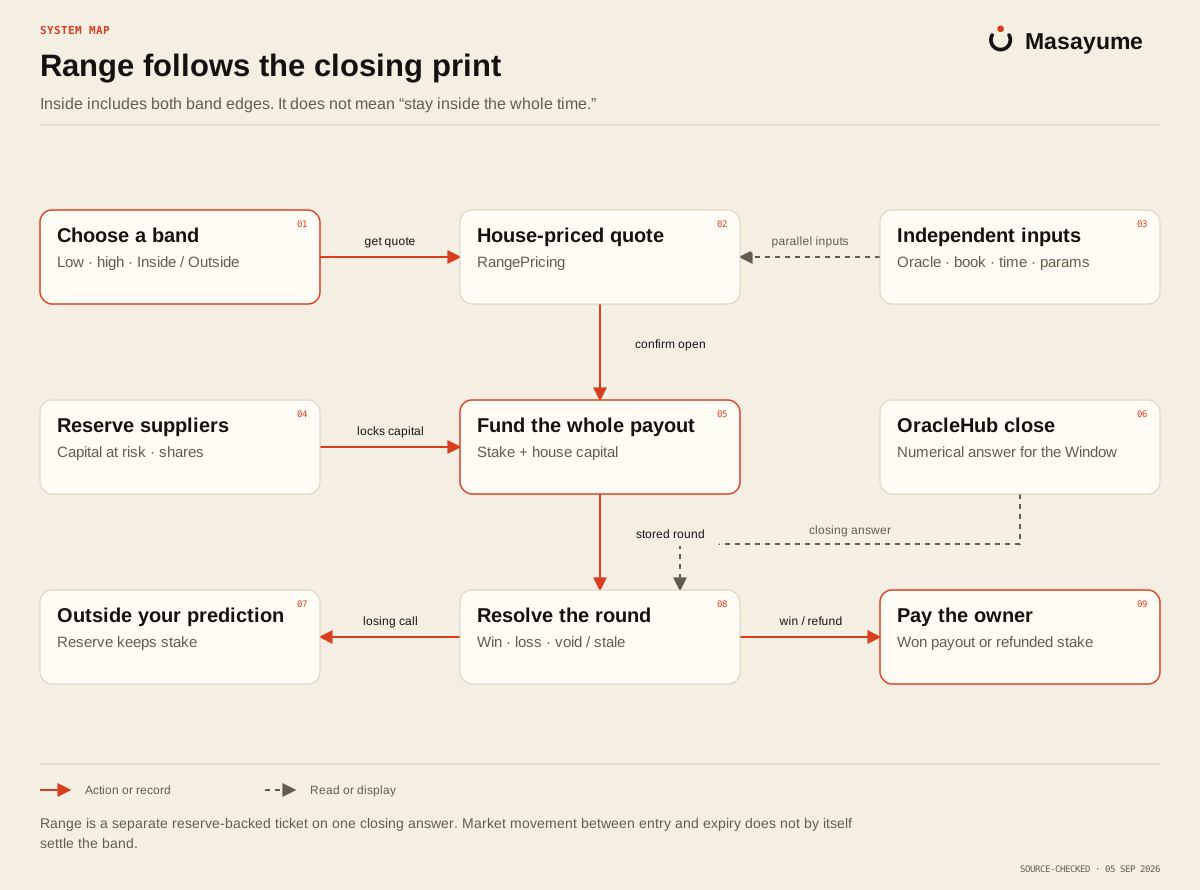
Read the map as text
- Choose a band House-priced quote: get quote.
- Independent inputs House-priced quote: parallel inputs.
- House-priced quote Fund the whole payout: confirm open.
- Reserve suppliers Fund the whole payout: locks capital.
- Fund the whole payout Resolve the round: stored round.
- OracleHub close Resolve the round: closing answer.
- Resolve the round Outside your prediction: losing call.
- Resolve the round Pay the owner: win / refund.
The three pricing inputs
| Input | Where it comes from |
|---|---|
| Opening print | The existing OracleHub answer for the start of the Window |
| Current market view | Available depth on the Window's Up and Down order books |
| Expected movement | A public volatility parameter for that asset, combined with time left |
RangeReserve uses those inputs to price the chosen band, applies its margin and calculates the stake for the requested maximum payout. The house's volatility is a parameter, not a promise about future prices.
The contract checks the asset against the Window's actual OracleHub question. It does not trust an arbitrary asset label supplied by the browser. It reuses existing oracle questions; Masayume does not schedule a new oracle job for each Range ticket.
What is backed before you sign?
The reserve locks the house-funded part of the maximum payout when your stake enters. Your stake plus that locked amount cover the ticket's payout.
A quote can be refused because the book is too thin or wide, too little time remains, the requested odds are outside allowed bounds, or the reserve has reached its liquidity or exposure limit. That refusal is preferable to showing a ticket the contract cannot fund.
What decides Inside or Outside?
After the oracle answers the Window's closing question:
- A closing print between the boundaries, including both boundaries, wins Inside.
- A closing print below the lower boundary or above the upper boundary wins Outside.
- A voided oracle answer refunds the stake.
- An unanswered question can be voided after the contract's configured stale delay.
Anyone can trigger settlement or claim, but a winning claim pays the ticket owner. A pending oracle answer is not a losing result.
Reserve suppliers
Suppliers own shares in the reserve. Losing stakes increase reserve capital; winning tickets consume it. Capital already locked behind tickets cannot be withdrawn as idle liquidity. This is exposure to ticket outcomes, not fixed-interest savings.
Moonshot also uses the Range machinery to present a target-oriented band. Its displayed multiplier still depends on an admissible, funded quote; the interface does not create a separate guaranteed payout rail.
Source notes
This guide follows the application code reviewed on 2026-09-07. Links point to that reviewed commit and require repository access. GitHub may show 404 if you are signed out or do not have access.