How the games work
Real market duels, verifiable draws and replayed arcade scores.
The games share Masayume's market data, but they do not all use the same proof or payout system.
Explore each part and its connections. Expand to use more of your screen.
Follow an arrow to explore a connected part.
Two players + committed deck
What this part does
The matchmaker pairs queued players and creates a deck commitment from verified seed material. Encrypted reveal material is journaled before publication.
Outgoing connections
- From Duel matchmakingcommit + enterAction or record
The matchmaker pairs queued players and creates a deck commitment from verified seed material. Encrypted reveal material is journaled before publication.
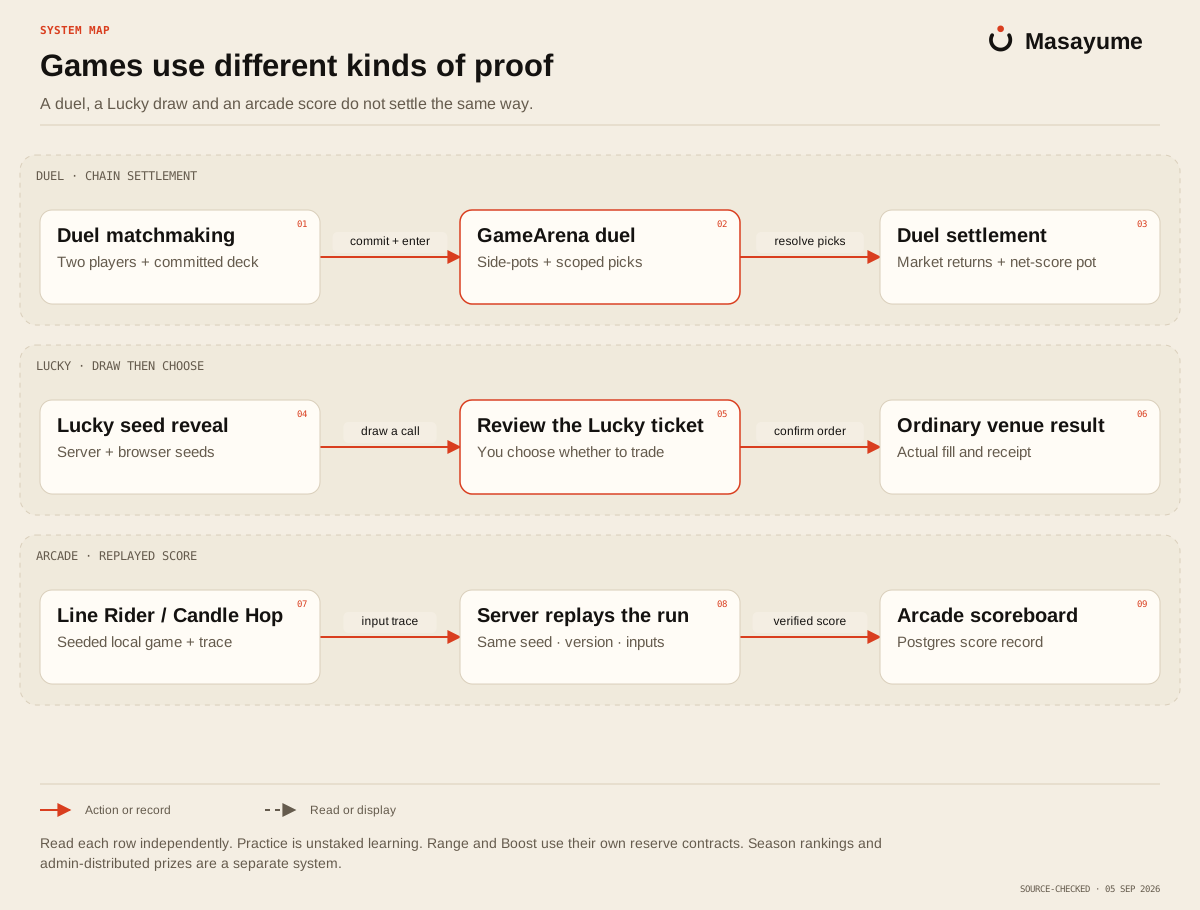
Read the map as text
- Duel matchmaking GameArena duel: commit + enter.
- GameArena duel Duel settlement: resolve picks.
- Lucky seed reveal Review the Lucky ticket: draw a call.
- Review the Lucky ticket Ordinary venue result: confirm order.
- Line Rider / Candle Hop Server replays the run: input trace.
- Server replays the run Arcade scoreboard: verified score.
| Game type | What is checked |
|---|---|
| Duel | The deck commitment, actual market fills, market payouts and side-pot rules are recorded on-chain. |
| Lucky | Disclosed seeds reproduce the draw; a separately confirmed market ticket supplies any financial result. |
| Line Rider / Candle Hop | A server replays the input trace and verifies the score. Scores are off-chain. |
A duel from queue to claim
- Two players queue by mode and tier. Matchmaking considers rating and waiting time.
- The players commit and reveal their seeds. The server builds a deck from eligible live Windows and saves encrypted reveal material before publishing the commitment.
- The creator opens a match naming the challenger and deposits the side-pot. The challenger joins and matches it.
- The committed deck is revealed. The contract checks its hash, unique cards, venue and remaining play time.
- Each player picks a side on each card. Every recorded pick is an actual filled market order.
- Resolved cards credit market payouts. The greater total of payout minus actual cost wins the side-pot. A tie splits it.
- Credits are claimed to the recorded player, even when someone else triggers the claim.
A browser agent key can sign picks after entry. Its authority is limited to one seat and match, with a budget based on the deck and tier. A sponsor may fund its transaction fees; the player still supplies the pot and stakes.
If play is interrupted
An unjoined match can be cancelled or refunded after its deadline. If the deck is not revealed in time, both pots can be refunded. After the pick deadline, a completed player beats an incomplete opponent by forfeit; two incomplete decks return both side-pots.
Already bought market positions are separate from the side-pot. They remain settleable even when a match is refunded. The current automatic settler skips refunded matches, so those remaining cards may need a manual contract recovery action.
A reconnect requests a fresh match snapshot. Queue state is temporary; committed deck material has an encrypted file journal and optional database copy.
Lucky does not place a bet by spinning
The server commits its seed before the browser contributes one. Together they derive an asset, side and target multiplier. The app then finds an eligible, fillable Window and shows its ticket. You still review and confirm it through the ordinary transaction flow.
The disclosed proof lets you reproduce the draw. It does not guarantee that a suitable market exists or that its future payout will win.
Arcade and seasons
Line Rider and Candle Hop run seeded, fixed-step engines. The server accepts a score only when replaying the recorded inputs reproduces it. That proves consistency with the engine, not that a human played unaided. Their scores are not on-chain prize evidence.
Season standings and eligibility are stored off-chain. The prize contract holds collateral, but an admin chooses and sends the one-time distribution. The displayed end time is informational; payout is not automatically triggered by the timestamp.
Source notes
This guide follows the application code reviewed on 2026-09-07. Links point to that reviewed commit and require repository access. GitHub may show 404 if you are signed out or do not have access.
- contracts/src/games/GameArena.sol
- contracts/src/games/ArenaAgents.sol
- contracts/src/games/ArenaMatches.sol
- contracts/src/games/SeasonPrizePool.sol
- services/ops/src/actors/matchmaker/seal.ts
- services/ops/src/actors/duel-settler/decide.ts
- web/src/features/games/arcade/score.server.ts
- web/src/features/games/lucky/lucky.server.ts